
Building in public
What Yaya Sithole has in common with startups

Of course it started with a mistake.
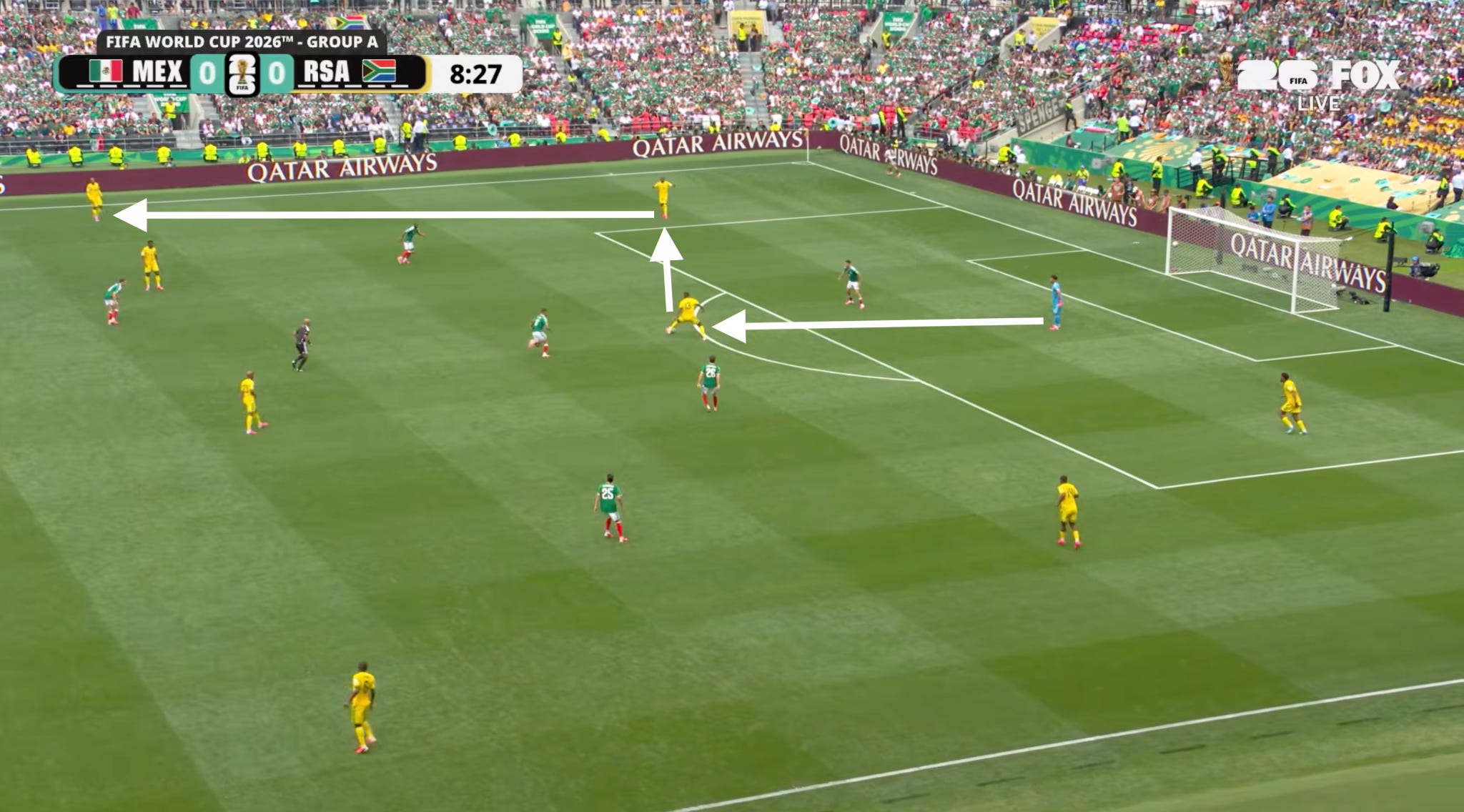
It just felt right that the very first highlight of a tournament whose entire run-up has been a series of embarrassing lowlights would be a disaster. Nine minutes into the first game, the South African midfielder Yaya Sithole turned into pressure he didn’t see coming, took one heavy touch into the path of Mexico’s onrushing Érik Lira and was left slipping around like a giraffe on rollerblades as Julian Quiñones slotted home the opening goal of the World Cup.
This is the exact scenario that footballers spend their entire lives dreading. Embarrassing doesn’t begin to cover it. If I made that mistake in front of billions of people I’d walk straight out of the stadium, past the team bus and onto the nearest long-range spacecraft in hopes that advanced lifeforms in some galaxy with spotty Telemundo reception might have a witness protection program where I could start a new life.
For most of the history of the World Cup, the fear of humiliation made this kind of mistake practically unheard of. Instead of risking turnovers in the defensive third, players were taught to blast the ball into the stratosphere at the first sign of danger. This wasn’t exactly peak entertainment but it was easy to understand: even if booting the ball away caused tactical problems, at least they were someone else’s problems now.
But something big has changed over the last twenty years. At the 2006 World Cup, the pass completion rate bottomed out at a dismal 76%, the lowest for any tournament since England yeeted their way to victory in 1966. By 2022, the completion rate had rebounded to an all-time high of 83%. You could see the shift in a pass sonar I made for The Athletic at the last World Cup: compared to the early Route One days, modern teams play much shorter, less direct passes. They complete more of them than ever in the buildup, but the incomplete ones can hurt a lot more.
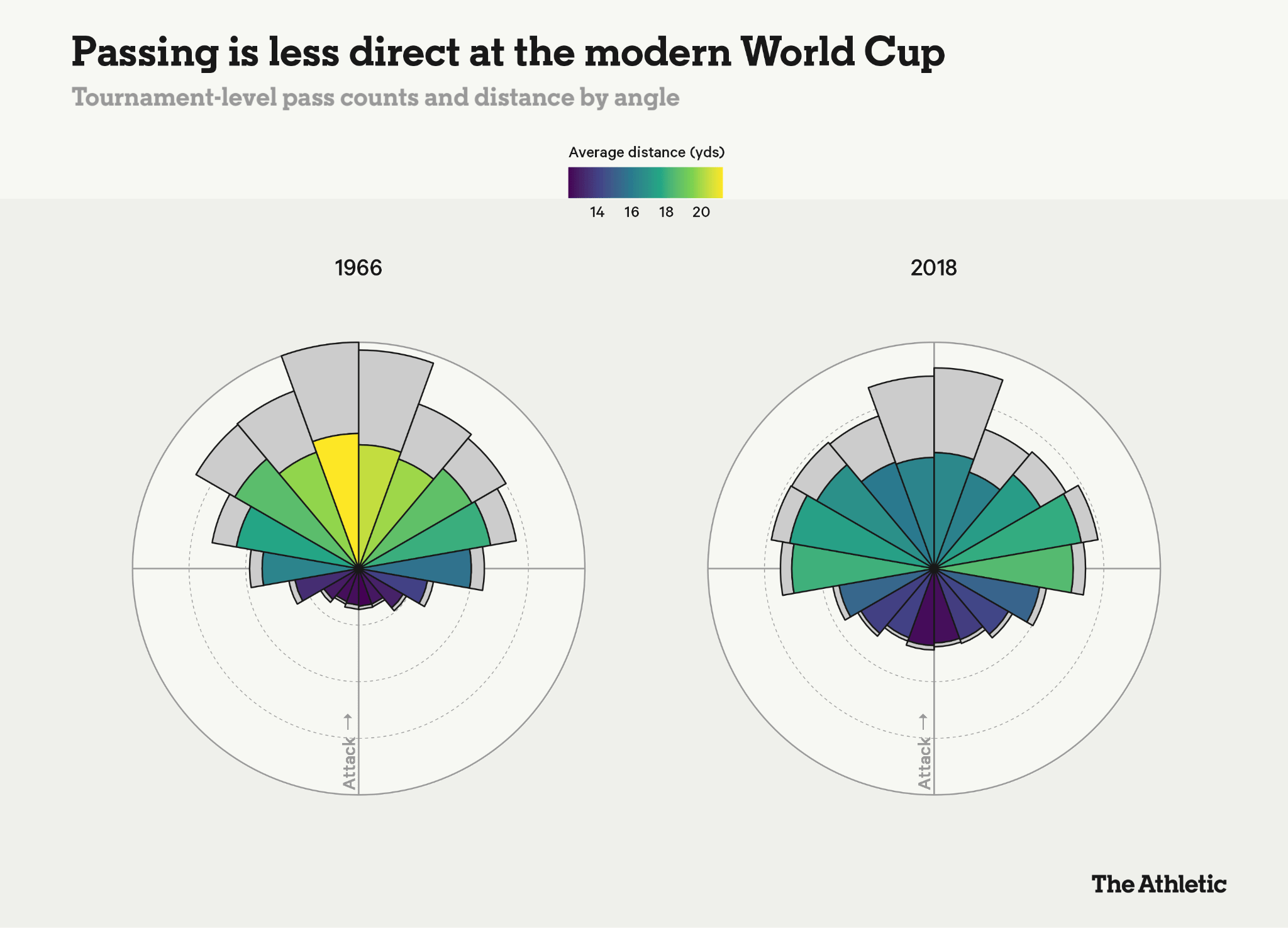
Why court the possibility of spectacular public embarrassment in front of your own goal? It has to do with a generational shift in how we think about football. Ever since the great Spain and Barcelona teams tiki-taka’d their way through danger and into our hearts circa 2008, the global game has been thoroughly Guardiolafied. Building from the back is taught at every level these days as not just romantic risk-taking but the optimal way to win. The trend has only accelerated since a 2019 change to the goal kick rule encouraged teams to develop tactics to pass their way out of their own penalty area even under heavy pressure. Building out, in the year 2026 CE (Cruyffian Era), is most definitely in.
If you paused the game the moment before disaster, you could sort of see why teams do this. The short pass from South Africa’s goalkeeper had already bypassed the first man in Mexico’s heavy press. If Sithole had managed to control the ball, he could have bounced it to the now-unmarked center back on the same side the pressure had come from — a standard buildup tactic — and Bafana Bafana would have been free up the right flank. By taking risks while building out, South Africa were hoping to earn the most valuable reward in football: time and space.
The more I thought about this play, the more I thought about futi.
That’s normal enough, I guess. I think about futi all the time. I’ve been thinking about it for a year and a half now as my co-founder Mike Imburgio and I have gone through the ups and downs of building a bunch of cool football models that we wished fans had access to, starting a business to put those models in an app, raising money, hiring designers and developers and fighting through all the exciting existential crises that are like 90% of building a startup. Finally, this morning, just a few hours before opening ceremonies at the World Cup that will determine if it was all worth it, we messaged the first few people in our Discord to go download the app.
Or at least it was only supposed to be a few people. In theory, our plan was to build a waitlist, invite a handful of early testers on day one and then spend some time working out the kinks before we put a more polished version in front of a bigger audience. What actually happened was our developers were so busy building the app that they didn’t have time to implement a formal invite system, which meant that pretty much the second futi hit the app store I started getting messages that my worst nightmare was happening: people were actually using it.
Don’t get me wrong, I want you to use futi. I want your dad and your grandmother and possibly your cat to use futi. Just, you know, maybe not all at once during the very first game of the World Cup, when the app was still teeming with day-one bugs. Bar charts were missing their bars, heatmaps were flipped and disallowed goals hung around on the scoreboard like a stale fart. Worst of all, exactly one day after I bragged about how futi has the most advanced player ratings in any football app, Sithole ended the worst afternoon of his professional life with a red card and exited the lineup in futi still showing a bright green rating of 99.
In startup world, this is called building in public. It’s supposed to be a good thing to get a half-broken app out there early and post through it while you make it better. The problem is I don’t come from startups — I come from journalism, where the best publications edit, fact-check and proofread the hell out of a piece before it ever sees the light of day; I also spent some time in law, which is worse. Building in public feels to me like inviting readers to watch me type a draft into Google Docs. It’s mortifying.
But a funny thing happened when we dropped the app link in the Discord and asked you guys to help us find everything wrong with it. It’s turned out to be fun. When Mike and I spent the Mexico-South Africa game chatting with users about all the things you’d like to see in futi, the whole thing started to feel real. People were choosing to hunt down an app we didn’t really even want them to know about yet, putting it on their phones, using it to follow the World Cup despite all the bugs and still caring enough to hop in the chat and tell us how to make it better. When I got over my initial embarrassment, I had to admit that was pretty damn cool.
This is where building in public starts to feel like building out of the back, I think. There’s potential to look stupid, sure, but if it comes off you might buy yourself time and space to create something special. Like twenty-first century football tacticians, I’m starting to come around to the idea that maybe fear was clouding my risk-reward calculations.
Guardiola himself never had any illusions about the hazards of buildup play. During that grim 2006 World Cup back when nobody could complete a pass, he wrote a beautiful paean to Ricardo La Volpe’s Mexico, the rare team where defenders didn’t just boot the ball long but went out with it “like lovers.”
“The Mexicans, living on the edge like this with their defenders, know the risk they run. Losing possession where they play can be terrible,” Guardiola wrote. “But they’re not the only ones who know this. Everyone knows this. That’s why everyone avoids playing like the Mexicans.”
These days everyone plays like the Mexicans, even South Africa, even me and Mike. Some days it can be risky, but it sure makes the game more fun.
I’m sure you notice but the excitement around Futi is palpable. The bugs are understandable and excusable, but the work you’ve done for years to democratize the game and connect fans to it has built up enough equity to handle even the toughest of launches (which this definitely was not).
You guys rock.
Pulisic has a lower rating than the Paraguay RB, would be fascinating to know the ins and outs of that?